
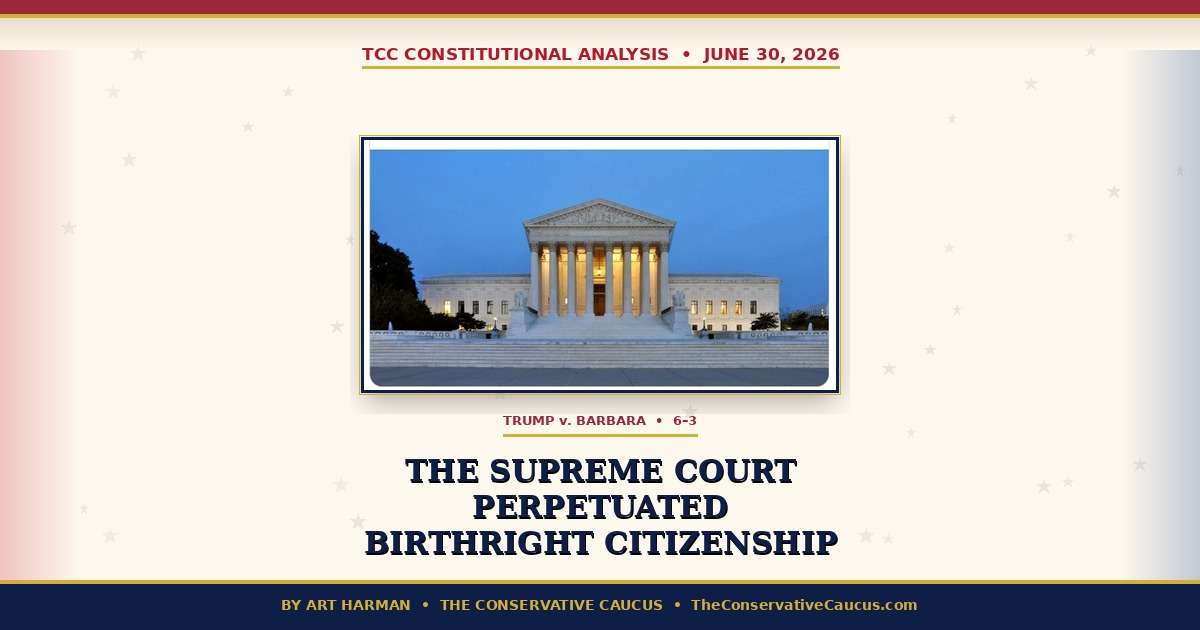
By Art Harman, Senior Vice President – Policy, The Conservative Caucus
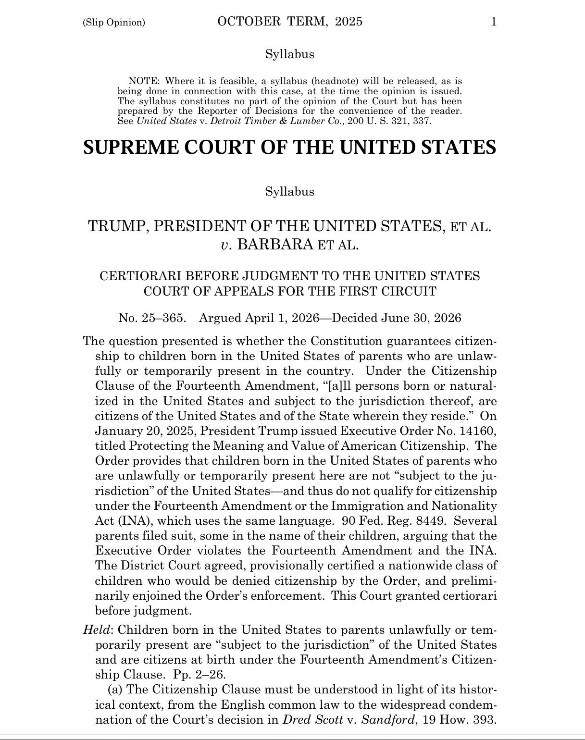
Conservatives were greatly disappointed in the Supreme Court 6-3 decision upholding birthright citizenship with no restrictions.
The questions asked by the Justices in their oral arguments on April 1, 2026 offered a near certainty that the decision would indeed be to uphold the existing free-for-all on birthright citizenship.
Publicity of this decision will attract millions more to take advantage of our system.
Birthright tourism is a massive industry, and includes a veritable ‘army’ of Chinese, whose children will have unrestricted access to our country. Many may become — or already are — controlled by the Chinese Communist Party and their military.
President Trump responded to the decision.
“The Supreme Court upheld Birthright Citizenship, which is too bad for our Country, but we can easily make it up in Congress through Legislation, with the support of the President, that has now been determined during this process. No long and unwieldy Constitutional Amendment is necessary! Congress should start TODAY to work on ending expensive and unfair to our Country, Birthright Citizenship. They will have my Complete and Total Support!”
— PRESIDENT DONALD J. TRUMP
The Majority Upheld Birthright Citizenship
Three Republican-nominated Justices joined with the Democrats on this decision.
Chief Justice John Roberts was joined by Justice Sonia Sotomayor, Justice Elena Kagan, Justice Amy Coney Barrett and Justice Ketanji Brown Jackson.
Justice Brett Kavanaugh (opinion concurring in the judgment and dissenting in part) agreed with the outcome that the executive order would be invalid, but wrote that he would have decided it on narrower statutory grounds rather than reaching the full constitutional question, leaving more room for Congress.
The Dissents Opposing Birthright Citizenship
Justice Clarence Thomas gave a lengthy dissent, joined by Justice Neil Gorsuch. He argued for an originalist reading requiring domicile (permanent residence) for full jurisdiction, and criticized the majority for departing from the Reconstruction-era understanding.
Justice Samuel Alito, in a separate dissent, called it one of the most important decisions in Court history but a “serious mistake.” He stressed exclusive allegiance and rejection of ‘feudal jus soli.’
Justice Neil Gorsuch wrote a separate dissent, in addition to joining Thomas’ dissent, focusing on allowing Trump’s executive order for temporary residents while distinguishing permanent ones.
In Their Words: The Dissents by Thomas and Alito
In the wake of the erroneous Supreme Court decision perpetuating birthright citizenship, it’s wise to read the dissents written by Supreme Court Justices Clarence Thomas and Samuel Alito.
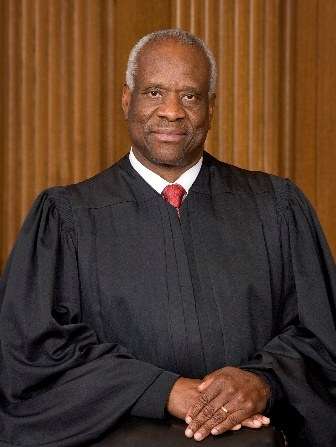
Justice Clarence Thomas:
“The 14th Amendment ‘was enacted for freed slaves such as Dred Scott, who had “a domicil” here… It was enacted for men such as Frederick Douglass… Its authors and supporters promised, over and over again, that it would exclude the children of “persons temporarily resident” here, whom “we would have no right to make citizens.”’”
“‘What do we mean by “subject to the jurisdiction of the United States?” Not owing allegiance to anybody else. That is what it means.’” (Sen. Trumbull, cited by Thomas)
All non-citizens owe their allegiance to the country of their citizenship. They cannot get a U.S. passport, but travel only on their home country’s passport.
“A person was ‘subject to the jurisdiction’ of the government of his domicile because of the legal relationships that followed from domicile… It determines his allegiance…”
Citizens of foreign countries can draft them into the army, allow them to vote, serve on juries, and cannot be deported. As foreigners in the U.S., they cannot be drafted, vote, serve on juries — and can be deported.
“The English feudal principle ‘was not accepted by the American governments.’… Americans ‘emphatically rejected’ this theory.”
“Children born in the United States, their ‘parents not being here domiciled, are not citizens.’” (citing Wharton treatise)
“What do we mean by “subject to the jurisdiction of the United States?” Not owing allegiance to anybody else. That is what it means.’” (Thomas quoted Sen. Trumbull, who emphasized complete jurisdiction, distinguishing it from partial allegiance (e.g., to foreign powers).
“Today, the Court does so again by recognizing a constitutional right to citizenship for the children of all foreign birth tourists and illegal aliens.” (Thomas was warning about devaluing citizenship.)
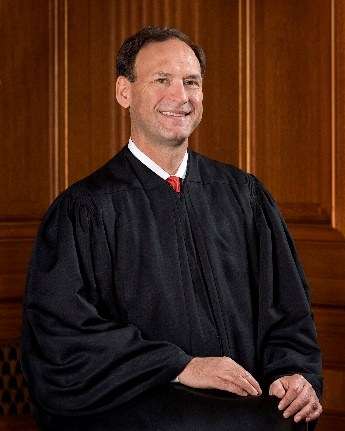
Justice Samuel Alito:
“This is one of the most important decisions in the history of the Court, and in my judgment, the Court has made a serious mistake. As interpreted by the Court today, the Fourteenth Amendment confers citizenship on virtually everyone who happens to be born in this country, including the children of ‘birth tourists,’ women who come here solely for the purpose of giving birth to a child and then promptly return home. … the Fourteenth Amendment confers citizenship on only those children who, at birth, owe allegiance solely to this country.”
Criticizing Wong Kim Ark: “Nor should we take the position that our hands are tied by dicta in a sprawling 19th-century opinion that is, to put the point gently, very far from a model of careful judicial craftsmanship. Too much is at stake.” (The Wong Kim Ark case falsely established the precedent of birthright citizenship)
“United States citizenship is precious. Anyone who has attended a ceremony where citizens are naturalized can see that message on the faces of those who take the citizenship oath. Before saddling the Nation with a medieval rule, we had better be certain the Constitution requires it.”
“The Declaration of Independence repudiated the foundation on which the British rule [of birthright subjecthood] was based. … With its foundation blown away, the British rule of birthright subjecthood was not suited for easy incorporation into American law.”
On the Citizenship Clause: “a person born here is not a citizen unless his allegiance to the United States is unimpaired by any obligations to a foreign power.”
Quoting Sen. Trumbull: “‘What do we mean by “subject to the jurisdiction of the United States?” Not owing allegiance to anybody else. That is what it means.’ … the authors of the two major provisions defining United States citizenship agreed that birthright citizenship required complete allegiance.”
“The Fourteenth Amendment confers citizenship on a person who is born in this country or naturalized only if that person is also ‘not subject to any foreign power.’”
“Suppose that a person’s only connection to this country is that he was born here to a mother who was present just long enough to give birth and then quickly return to her native country. Suppose that country is a strategic adversary or enemy of the United States. … According to this Court now that person is a citizen of the United States. He can enter and leave the country as he pleases. He can travel the world on a United States passport even if he plots to harm this country. He cannot be deprived of his status as a citizen…” (On national security implications, particularly China.)
On consequences and congressional role: “Respecting this interpretation would not require uprooting the millions of children who were born here to mothers who entered or remained in this country illegally. … Congress can and should address their situation. … The Fourteenth Amendment dictates who must be a citizen, but it does not address who may be a citizen by Act of Congress.”
The History of Birthright Citizenship
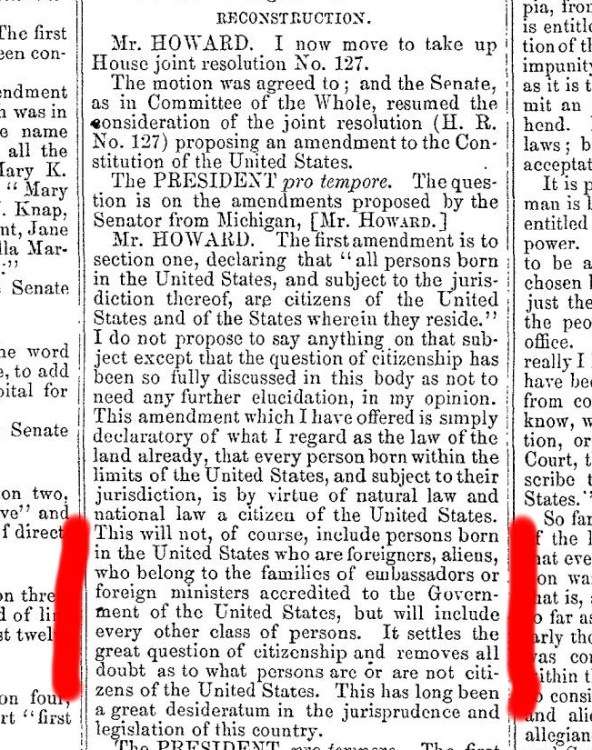
Senator Jacob M. Howard (R-MI) was one of the key authors of the 14th Amendment, particularly its Citizenship Clause.
He wrote the Citizenship Clause in May, 1866.
“All persons born or naturalized in the United States, and subject to the jurisdiction thereof…” He made a number of explanations of its meaning, including this remark on the Senate floor on May 30, 1866 while introducing the citizenship clause of what became the 14th Amendment.
“This amendment which I have offered is simply declaratory of what I regard as the law of the land already, that every person born within the limits of the United States, and subject to their jurisdiction, is by virtue of natural law and national law a citizen of the United States.
“This will not, of course, include persons born in the United States who are foreigners, aliens, who belong to the families of ambassadors or foreign ministers accredited to the Government of the United States, but will include every other class of persons. It settles the great question of citizenship and removes all doubt as to what persons are or are not citizens of the United States.”
This was the exact and clear intent of the author of the language.
Today’s Justices should have ignored the erroneous 1898 U.S. v. Wong Kim Ark case, and ruled only on the plain language of the 14th Amendment and the well-known and documented intent of the author.
The mistake Senator Howard’s made in drafting the 14th Amendment was in assuming that later generations would be as educated as they were in his time. Howard assumed that his language of “subject to their jurisdiction” was obvious and sufficient.
The above was part of his explanation of the clause “All persons born or naturalized in the United States, and subject to the jurisdiction thereof, are citizens of the United States and of the State wherein they reside.”
Howard described his language as largely restating existing law (similar to the Civil Rights Act of 1866) and clarified the “subject to the jurisdiction” qualifier.
The Birthright Industry
The estimated annual revenue to birth tourism organizers — such as agencies, maternity hotels, and service providers — in the U.S. is in the range of $200–500 million, based on available industry analyses and case studies.
Organizers typically charge $20,000–$100,000 per package (covering visas, housing, medical coordination, transportation, and sometimes shopping/nannies).
Estimates of birth tourism births annually number 20,000–36,000. There are primarily from China, Russia, South Korea, Nigeria, Turkey, and some Latin American countries. Middle Eastern birth tourism also exists.
At conservative averages of $30,000–$50,000 total tour package spend (with organizers taking a substantial cut), revenue falls in the hundreds of millions.
ICE reported that one California scheme collected $3 million in wire transfers over two years; others were described as “multimillion-dollar” businesses.
These organized tourism trips don’t count the millions of illegals whose children become automatic citizens, and allows for chain migration. Likewise self-organized birthright trips are not counted.
Block Them
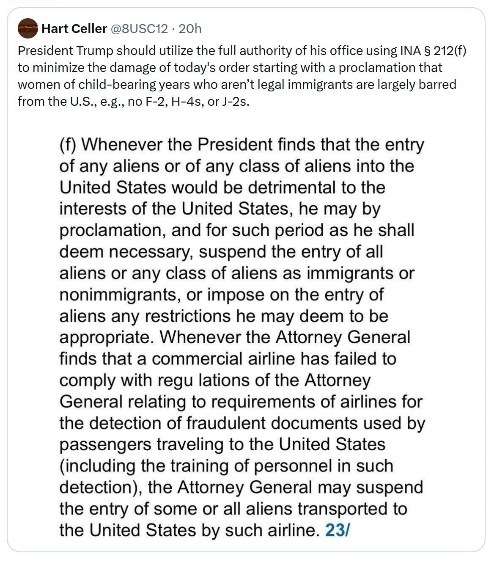
While the decision allows children of illegals to become citizens, what if the expectant mothers aren’t let in in the first place?
In the law, INA § 212(f) (codified at 8 U.S.C. § 1182(f)), is a key provision of the Immigration and Nationality Act that grants the U.S. President broad authority to suspend or restrict the entry of noncitizens into the United States:
“Whenever the President finds that the entry of any aliens or of any class of aliens into the United States would be detrimental to the interests of the United States, he may by proclamation, and for such period as he shall deem necessary, suspend the entry of all aliens or any class of aliens as immigrants or nonimmigrants, or impose on the entry of aliens any restrictions he may deem to be appropriate.”
— INA § 212(f), 8 U.S.C. § 1182(f)
This law has been used by presidents from both parties, including by Reagan, Bush, Obama, Trump and Biden for travel bans, as well as for health-related suspensions as during Covid.
One proposal is for President Trump to use INA § 212(f) as above to minimize the damage from the Court’s decision by proclaiming that women of child-bearing years who are not legal immigrants are barred from the U.S., e.g., no issuance of F-2, H-4 or J-2 visas that allow family members to accompany or join the birthright citizen in the United States.
Use of this law could be used in deportation proceedings, as well as for those applying for admittance or asylum.
The State Department explicitly stated that no foreigner is permitted to obtain a visitor visa for the primary purpose of acquiring U.S. citizenship for a child by giving birth in the U.S., emphasizing the integrity of U.S. citizenship.
Secretary of State Marco Rubio has uncovered organized “birth tourism” networks, including one involving over 100 foreigners who used fraudulent documents, visa “fixers,” and coaching to obtain visitor visas primarily for giving birth in the U.S. to secure citizenship for their children. The network was shut down, and the visas were revoked. Other actions extended to North Africa and Europe, with hundreds more suspected cases identified, involving companies coaching applicants and arranging U.S. housing and delivery.
This builds on President Trump’s 2020 visa rules that targeted birth tourism. The actions target visa fraud and misuse, which is completely untouched by the SCOTUS decision.
The Numbers
- Over the last 25 years, annual births to illegal alien mothers in the U.S. have ranged from about 215,000 to 380,000, and totaling roughly 5.1 million from 2006–2023. These represent about 7–9% of all U.S. births.
- The greater majority of these births are to mothers from Latin America and especially from Mexico. Those account for the bulk of both illegal and legal alien mothers giving birth in the U.S.
- Births to all foreign-born mothers, including legal immigrants, have consistently made up 21–25% of total U.S. births, or roughly 800,000–900,000 annually in recent years.
- Total births to Chinese-born mothers (including legal and illegal immigrants and temporary visitors) number approximately 800,000 to 1.1 million since 2000.
Chain Migration — How It Works
Birthright citizenship created ‘chain migration,’ a danger to our nation the Supreme Court ignored in this landmark decision.
A child is born in the United States to parents who are legal or illegal immigrants. That child automatically becomes a U.S. citizen at birth. The child becomes an “Anchor” at age 21.
At that time, they can petition for their parents — including illegal alien parents — to receive green cards for permanent residency. This is allowed under the Immigration and Nationality Act.
The parents can then live and work permanently in the U.S. and eventually apply for citizenship.
After the parents become green card holders or citizens, they can sponsor their other children, and eventually, those siblings can sponsor their relatives.
This creates a multi-generational chain that can legally bring dozens of relatives to the U.S. over the years.
Looking only at the tens of millions of illegals that Biden welcomed to the U.S., you can see how many millions of citizens are created; often from cultures hostile to American values and our liberty.
When Democrats Opposed Birthright Citizenship
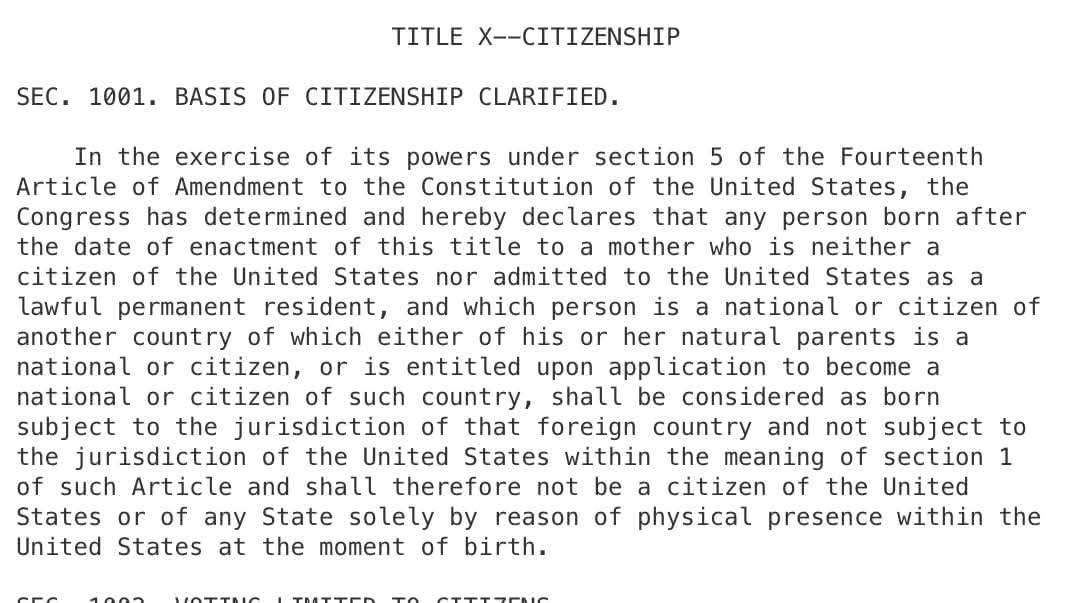
In decades past, many Democrats did oppose illegal immigration and birthright citizenship. Then the party decided to use mass immigration, both legal and illegal, to gain a permanent majority in government. In robotic unison, they now parrot the same lines favoring unlimited illegal and legal immigration. Especially illegals, because they would become loyal Democrat voters for protection from their immigration and other crimes, and for generous welfare benefits.
Senator Harry Reid (D-NV) gave a 1993 Senate floor speech when introducing legislation to limit birthright citizenship. “If making it easy to be an illegal alien isn’t enough, how about offering a reward for being an illegal immigrant? No sane country would do that. Right? Guess again. If you break our laws by entering this country without permission and give birth to a child, we reward that child with U.S. citizenship and [a] guarantee of full access to all public and social services this society provides — and that’s a lot of services.”
Reid’s bill sought to clarify that children born to mothers who were neither U.S. citizens nor lawful permanent residents would not automatically receive citizenship.
Senator Dianne Feinstein (D-CA) also spoke in 1993: “Should you have a system where people can come to this country, even if they’re well-to-do? Get on Medicaid and give birth to a baby, then go back? The answer is no! And we know that Medicaid laws are being used and abused to do just this in the state of California. I’d like to see that stop.”
Congressman Anthony Beilenson (D-CA) gave congressional testimony in 1995 supporting a constitutional amendment to limit birthright citizenship:
“Mr. Chairman, I appreciate this opportunity to come and testify before your subcommittee in support of denying automatic birthright citizenship to U.S.-born children of illegal immigrants. … Because it appears to be necessary to amend the Fourteenth Amendment of the Constitution to achieve that goal, I have introduced a proposed constitutional amendment… This proposal… would provide that automatic U.S. citizenship for persons born in this country will be granted only to the children of citizens and persons with a legal resident mother or father.”
These are the Democrat bills:
Senator Harry Reid (D-NV) S. 1351 — Immigration Stabilization Act of 1993 (introduced August 4, 1993).
This immigration bill sought to clarify the 14th Amendment’s Citizenship Clause. It declared that a child born in the U.S. to a mother who was neither a U.S. citizen nor a lawful permanent resident (and who had foreign nationality ties) would not be considered “subject to the jurisdiction” of the U.S. and thus not entitled to birthright citizenship.
Representative Anthony Beilenson (D-CA) introduced two resolutions proposing a constitutional amendment to restrict automatic birthright citizenship to children with at least one parent who is a U.S. citizen or lawful permanent resident.
Perhaps Sen. John Fetterman will carry forward Reid’s important work.
Is There a Future Hope?
The comprehensive dissents by Justices Thomas and Alito were both educational for the interested public and scholars, but more importantly, they lay a foundation for a future Court to perhaps overrule this decision.
While Justice Kavanaugh sided with the majority in opposition to the plain language and intent of the 14th Amendment, he believes President Trump’s executive order does not violate the amendment as the majority interpreted it. His recommendation:
“The Court today holds that the Order violates the Fourteenth Amendment to the Constitution. I respectfully disagree with the Court’s constitutional holding. In my view, the Executive Order does not violate the Fourteenth Amendment. But the Order does contravene a federal statute, 8 U.S.C. §1401(a). Congress could — consistent with the Fourteenth Amendment — amend §1401(a) or otherwise enact new legislation establishing exceptions to birthright citizenship for children born to foreign citizens unlawfully or temporarily in the country. But Congress has not yet done so.”
— JUSTICE BRETT KAVANAUGH
Certainly if the future brings a couple additional originalist Justices, a case might be brought to review again the 14th Amendment using the Thomas and Alito dissents to end the practice.
A constitutional amendment would be impossible to pass and get ratified as long because radical, pro-illegal alien, anti-constitutionalist Democrats rule more than 13 states, and the astronomical risks of an ‘Article V’ constitutional convention precludes the use of that sometimes-mentioned option.
President Trump succeeded in ending illegal immigration, and the full border wall might be completed by the end of his term. That will greatly reduce future birthright claims.
Democrat politicians have staked their vision for the future on a resumed invasion of millions more illegals; anti-Americanism; hard core socialism; defunding the police; violent riots; tax hikes, and more homeless encampments. That radical and hateful agenda offers hope for avoiding a Democrat presidential victory in 2028.
Final Words
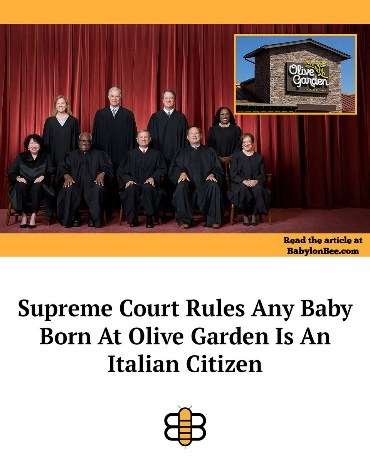
The dangers to our republic from this loss are real. It will encourage many more to come to America, both legally and illegally, for the ultimate prize of birthright citizenship. Our enemies will take further advantage of planting loyalists who become citizens.
President Trump has called on Congress to legislatively restrict birthright citizenship. It’s unclear if there remains a serious solution other than limiting birthright tourists and keeping our borders closed.
However, we remain thankful that during President Trump’s presidency and hopefully with a conservative successor, our border will remain closed to illegals, which dramatically limits future arrivals intending on claiming the birthright prize. We may also see increased blocking of the entry of likely birthright tourists.
Your Conservative Caucus will keep you informed on developments on this and related issues — and how you can take grassroots action.
— Art Harman, Senior Vice President – Policy, The Conservative Caucus
SHARE THIS ANALYSIS
Support Independent Conservative Analysis
Your donation keeps The Conservative Caucus holding government accountable since 1974.
About the author: Art Harman is Senior Vice President – Policy at The Conservative Caucus.
About The Conservative Caucus: Founded in 1974, The Conservative Caucus is a grassroots public policy action organization. Under President Jim Pfaff, the Caucus advances free enterprise, limited government, and traditional values.
Published June 30, 2026 by The Conservative Caucus.


 Peter J. Thomas is a veteran conservative political strategist and seasoned policy expert dedicated to upholding the principles of the Constitution and democracy. As a founder and the chairman of the Conservative Caucus, he has played a pivotal role in promoting and shaping the conservative agenda across the nation for over half a century.