
By Art Harman, Senior Vice President – Policy, The Conservative Caucus
“I consider it completely unimportant who in the party will vote, or how; but what is extraordinarily important is this — who will count the votes, and how.”
— JOSEPH STALIN

We watched it happen. Spencer Pratt, the independent candidate for Mayor in Los Angeles, won a place on the November ballot in the primary election on June 2, 2026 — but then lost it when the lesser-known 3rd-place socialist candidate received an unusually large number of additional ballots in the days after the election.
Bill Essayli, the First Assistant U.S. Attorney for the Central District of California, announced on June 5 “multiple election fraud investigations” related to California’s elections, in coordination with the FBI, and sent a prosecutor to Los Angeles County’s ballot-processing center.
Essayli said the office is working with the Department of Justice’s Civil Rights Assistant Attorney General Harmeet Dhillon “to conduct a comprehensive audit of California’s voter rolls,” and described California’s elections as having “serious structural vulnerabilities.”
This followed President Trump’s claims on Truth Social of “big cheating by the Democrats in California” as late-counted, Democratic-leaning mail ballots narrowed leads for his preferred candidates for governor and L.A. mayor.
State officials, including Secretary of State Shirley Weber, defended the slow count as legally required: “Accuracy comes before speed.” Yet most states can count everything on the night of the election.
The Real Story Isn’t the Fraud — It’s the Structure
There’s a lot of institutionalized fraudulent opportunity in California. Whatever investigators find, the real story is the structure that enables fraudulent activities. The investigations may well turn up fraud and other crimes. Some may even go to jail.
But the more important point goes back many years:
California legalized a set of processes specifically engineered to make fraud nearly impossible to detect — using standards and rules that, in other states, either deter fraud up front or expose it after the fact, in ways California law no longer can.
The scandal isn’t only what might be found; it’s that the system was built so that fraud wouldn’t be found.
The Engineered ‘Flaws’
These are the greatest of the engineered ‘flaws’ that empower virtually unlimited opportunities for fraud in California:
- Universal mail-in ballots, whereby roughly 85% of California voters vote by mail. These are automatically mailed to all registered voters.
- Voter lists are not ‘cleaned’ of people who are deceased or have moved. Live ballots end up at the homes of new residents that could easily be ‘voted’ by the new recipients.
- No voter ID — and a 2025 law makes it illegal to even ask for an ID.
- Ballots may be received up to seven days after the election.
- A 30-day ballot-counting period after election day.
- Anyone can write on the ballot a handwritten date for before June 2 and turn it in after election day.
- Third-party ballot collection (ballot harvesting) is legal — “anyone may return your ballot.” Think the harvesters won’t throw out non-Democrat ballots?
- Unlimited ‘ballot harvesting’ can continue within the 7-day period following the election.
- Postmarks can be ignored if the ballot was dated (truly or falsely) by election day. Few letters even get an actual dated postmark these days.
- A signature standard set at the criminal-trial standard of “beyond a reasonable doubt” makes rejection of uncertain or non-matching signatures nearly impossible.
Each of these flaws might be defensible in isolation; together they remove every checkpoint that lets the public verify and trust the result — including ID, custody, timely count, and adversarial challenge.
“Beyond a Reasonable Doubt” — for a Signature
Let’s look at what the criminal-trial standard of “beyond a reasonable doubt” means in practice.
California requires that before a mail ballot is rejected for a signature mismatch, two different elections officials must unanimously find, “beyond a reasonable doubt,” that the signature differs in multiple, significant, and obvious respects from all signatures on file. Sources: California Elections Code §3019 and 2 CCR §20960(j).
Officials are required to presume the signature is valid; an exact match is not required; missing or mismatched signatures trigger a mandatory notice-and-cure process (the county must notify the voter within one business day and the voter has 21 days to show proof).
“Beyond a reasonable doubt” is the criminal-conviction standard, the highest in law — smuggled into an administrative process where it has never belonged. It’s a legal standard built to prevent wrongful conviction that was repurposed to prevent ballot scrutiny. (In re Winship, 397 U.S. 358 (1970); administrative determinations normally use preponderance of the evidence.)
In practice, could the most responsible, non-ideological person look at a clear signature from the original voter registration form, then look at the ballot that has a smudge, an “X” or an obvious scribble, and — obeying the “beyond reasonable doubt” standard — be forced to imagine “perhaps the person was in a hurry, is now elderly, or has poor eyesight”?
That’s the impossible ‘beyond reasonable doubt’ standard in action. And both of the ballot validators would have to agree that it’s false beyond a reasonable doubt. Should one or both be ideologically motivated to approve mass quantities of obviously-falsified ballots for their candidate, they would feel pretty secure that the extremely high “beyond a reasonable doubt” standard would protect them from any scrutiny.
What Other States Do — That California Eliminated
Many states have excellent detection-and-deterrence laws and practices — ones that California has deliberately eliminated:
- Mandatory voter ID.
- Tighter chain-of-custody for ballots, with receipt limited to election day.
- Shorter and more transparent ballot-counting windows.
- Not automatically mailing live ballots to all registered voters.
- Even North Carolina, which shares California’s high signature-rejection bar, pairs it with voter ID and other safeguards.
So the issue is not any particular rule — it’s California’s aggregate removal of all the proven mechanisms that catch or deter fraud.
No system can absolutely prevent fraud. Therefore, the goal must be to make fraud much harder to commit and much easier to detect.
Critics may say that signature verification rules exist in about 32 states and that a slow count is legal. But few other states use the criminal-grade standard of proof “beyond a reasonable doubt” — and few have such a high level of overall opacity.
Elections Are the Province of the People
That’s you and me.
For roughly 230 years, American elections were administered by the people and were adversarially challengeable by the people. Even more than impossible signature standards, electoral integrity is undermined by the displacement of the people-administered tradition by a closed administrative apparatus that the public cannot meaningfully audit.
The Guarantee Clause — Article IV, Section 4: “The United States shall guarantee to every State in this Union a Republican Form of Government.” A republican form means the people, not an unaccountable apparatus, govern their own elections.
While courts have largely declined to enforce the Guarantee Clause (treated as “non-justiciable”: Luther v. Borden 1849; Pacific States Telephone 1912; Baker v. Carr 1962 routed such questions through Equal Protection instead), as TCC President Jim Pfaff puts it: “A guarantee no one will enforce is not a repealed guarantee — it is an open invitation.” Court non-enforcement does not make the constitutional principle invalid.
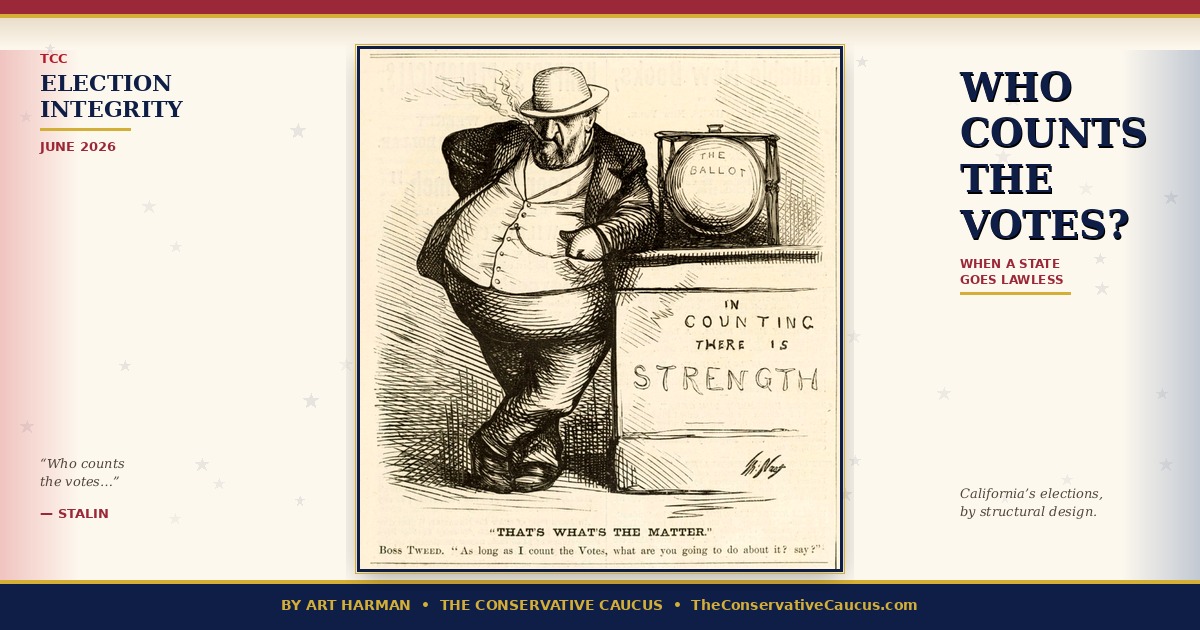
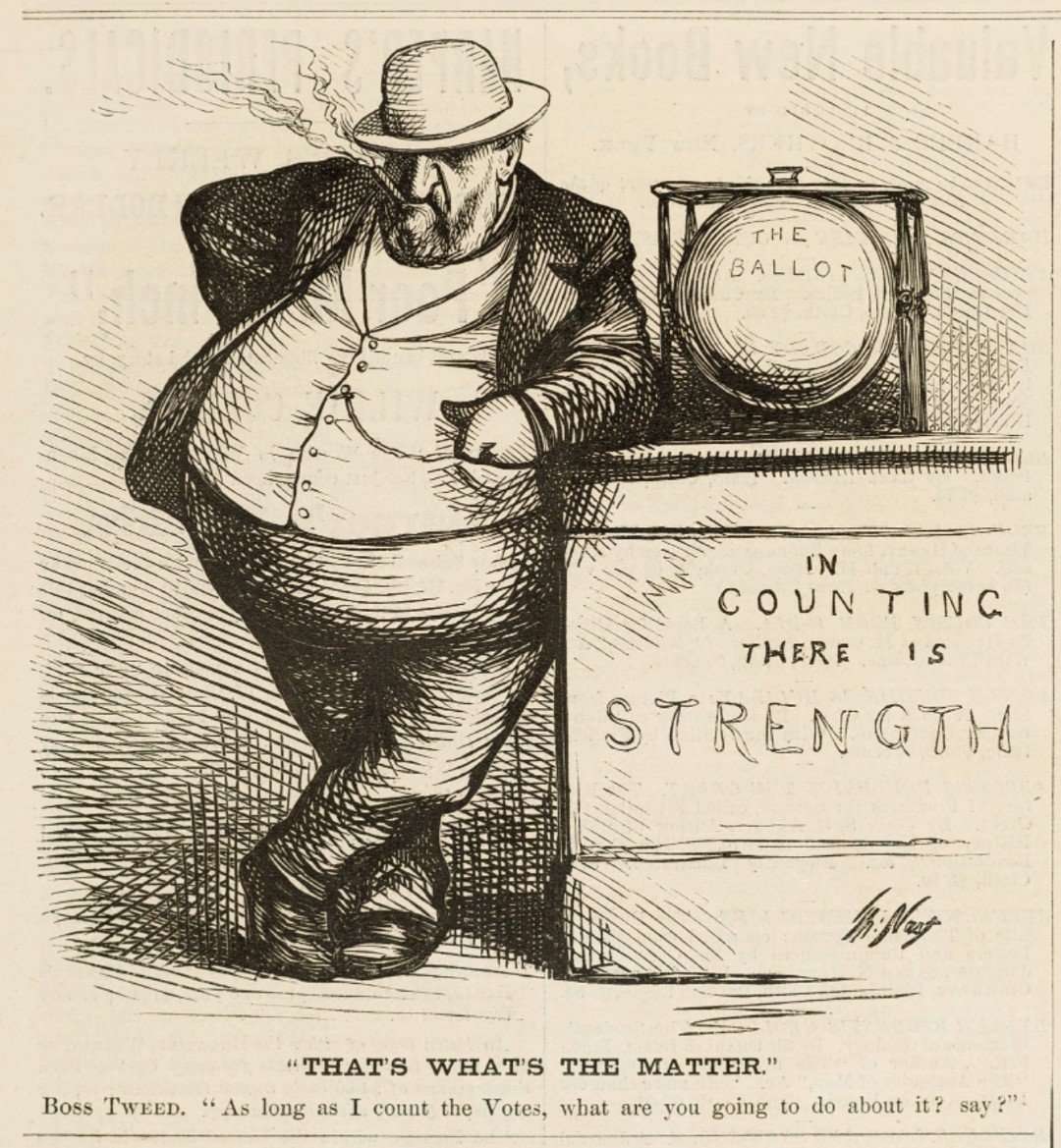
Examples of voter fraud and intimidation that pre-date today’s highly-organized systems include “Tammany Hall,” which was concentrated machine power that ruled New York City for more than 150 years — where the infamous Boss Tweed ruled his corrupt political machine in the 1860s. Following Reconstruction, racist “Jim Crow” laws were passed by Democrats which lasted for nearly a century. Those were lawless violations of plain law and a failure to uphold the Constitutional provision of a republican-form guarantee of voting rights. Those were confirmations that the design’s safeguards matter — not counterexamples.
When Combatting Voter Fraud Was Bipartisan

A 2005 bipartisan commission by Jimmy Carter and James Baker — the Commission on Federal Election Reform — issued its report titled Building Confidence in U.S. Elections.
The commission’s report was blunt: “Absentee ballots remain the largest source of potential voter fraud.”
Their recommendations included “Prohibit or strictly limit ‘third-party’ handling of absentee ballots (e.g., ballot harvesting by candidates, parties, or activists).”
“A notorious case of absentee ballot fraud was Miami’s mayoral election of 1998 — and in that case, the judge declared the election fraudulent and called for a new election.”
“Absentee balloting is vulnerable to abuse in several ways: blank ballots mailed to the wrong address or to large residential buildings might get intercepted. Citizens who vote at home, at nursing homes, at the workplace, or in church are more susceptible to pressure, overt and subtle, or to intimidation.”
“State and local jurisdictions should prohibit a person from handling absentee ballots other than the voter, an acknowledged family member, the U.S. Postal Service or other legitimate shipper, or election officials. The practice in some states of allowing candidates or party workers to pick up and deliver absentee ballots should be eliminated.”
“All states should consider passing legislation that attempts to minimize the fraud that has resulted from ‘payment by the piece’ to anyone in exchange for their efforts in voter registration, absentee ballot, or signature collection.”
The Late-Ballot Surge — Statistically Indistinguishable from Zero

An analysis of the probability of the 3rd-place candidate in the Los Angeles Mayor race, Nithya Raman, dramatically surging to pass second-place candidate Spencer Pratt revealed a zero-percent chance it was organic.
“The probability of only socialist Raman surging percentage-wise across post-Election Day tallies — via natural voter behavior — is statistically indistinguishable from zero given the batch ratios and swing size. Under assumed harvesting mechanics + existential motive to neutralize Pratt’s threat, this fits a deliberate late-ballot injection model far better than chance.”
— STATISTICAL ANALYSIS (calculations via Grok)
Caught in the act. During this election, online videos appeared to show homeless people admitting they were being paid to fill out multiple ballots on the streets of Los Angeles and were videoed falsifying ballots using names provided from voter rolls. Given the extremely high level necessary to reject signatures, the likelihood is that most such ballots would be routinely accepted.
Fraud isn’t new in elections — it’s as old as the nation; electoral bribery was common in ancient Rome. Together, these practices are how corrupt politicians have perpetuated one-party rule, massive corruption, and condemned their residents to live in a state of crime, drugs, homeless encampments, and the highest gas prices in the nation.
Conclusion
As Americans, we understand our elections are the province of the people — a republican form of government as specified in Article IV, Section 4 of the Constitution. That means the people must be able to verify their own elections.
Our goal isn’t necessarily to allege fraud to make this case — we’ve read the many investigatory reports about the election just as you have. California voters desperately need a system that the public can actually check and trust. California built one designed to resist exactly that — and that, by itself, is the problem.
If Republican candidate Steve Hilton should be elected as California’s governor in November, he will be in a position to safeguard elections as best he can through executive actions, knowing the Democrat-controlled legislature would defeat any bills to fully secure elections.
The California election highlights why on the national level the SAVE America Act is so essential. It doesn’t apply to state elections, but would help safeguard our elections for the U.S. House, Senate and Presidency — and it would provide a model for state election reforms.
During this election year, you’ll be able to meet your incumbent and new candidates for House and Senate. Take the opportunity to talk to them at campaign events and civic meetings.
Action Items
- Demand the SAVE America Act. Call your Senators at the U.S. Capitol Switchboard: 202-224-3121.
- Track your state’s election rules. Where does your state stand on voter ID, signature standards, ballot harvesting, and the receipt window?
- Get involved locally. Become a poll watcher or election judge. The system needs eyes from both sides.
- Meet your candidates. This election year, talk to incumbents and challengers at campaign events. Ask their position on election integrity.
- Share this analysis. The structural argument matters more than any single incident.
— Art Harman, Senior Vice President – Policy, The Conservative Caucus
SHARE THIS ANALYSIS
Support Independent Conservative Analysis
Your donation keeps The Conservative Caucus holding government accountable since 1974.
About the author: Art Harman is Senior Vice President – Policy at The Conservative Caucus.
About The Conservative Caucus: Founded in 1974, The Conservative Caucus is a grassroots public policy action organization. Under President Jim Pfaff, the Caucus advances free enterprise, limited government, and traditional values.
Published June 15, 2026 by The Conservative Caucus.


 Peter J. Thomas is a veteran conservative political strategist and seasoned policy expert dedicated to upholding the principles of the Constitution and democracy. As a founder and the chairman of the Conservative Caucus, he has played a pivotal role in promoting and shaping the conservative agenda across the nation for over half a century.