
By Art Harman, Senior Vice President – Policy, The Conservative Caucus
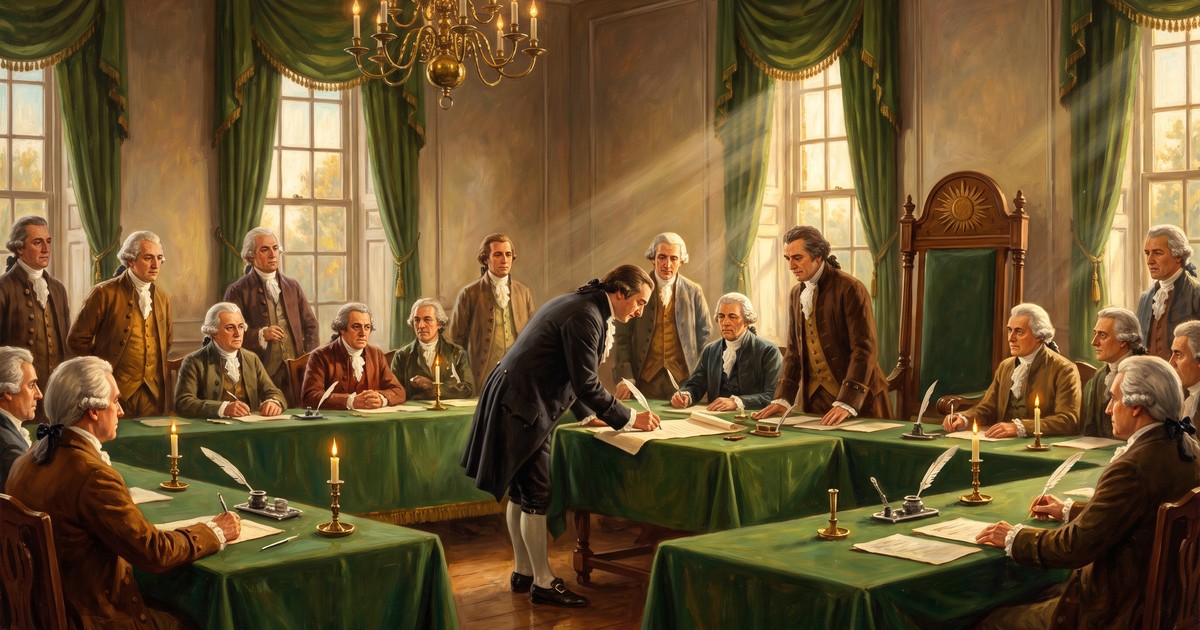
In this 250th year of our independence and liberty, let us commemorate the signing of the Constitution on September 17, 1787. The Constitution took effect in 1789, when the new government began operating under it.

Eleven years separated the signing of our Declaration of Independence and the signing of our Constitution.
Interestingly, there were eight of the 56 who signed the Declaration and also participated in drafting the Constitution, and six of those also signed the Constitution.
There were a few who signed both documents: George Clymer (PA), Benjamin Franklin (PA), Robert Morris (PA), George Read (DE), Roger Sherman (CT) and James Wilson (PA).
These two were delegates but did not sign the Constitution: Elbridge Gerry (MA) attended and spoke frequently. He chaired a key committee, but refused to sign over lack of a bill of rights and other concerns. George Wythe (VA) attended early sessions, then left in June 1787 due to his wife’s illness and resigned.
Thirteen of the 56 had already died by the time the Constitution was signed. Most of these deaths occurred during or shortly after the Revolutionary War.
In those 13 intervening years, the original Articles of Confederation were found to be inadequate for the growing nation, which resulted in convening the Constitutional Convention to create a more stable governmental structure.
Under the Articles, there was no separate executive branch and no president with real governing power. The Congress would elect one of its members as the “President of the United States in Congress Assembled,” which was a largely ceremonial officer who presided over sessions, signed documents, and handled official correspondence for a one-year term.
The president had no authority to enforce laws, command forces, or appoint officials. Those were the reasons that the Framers created a distinct, elected chief executive in the Constitution.
How and why did the Articles of Confederation get entirely replaced?
The Articles governed starting in 1781, but was less a national government than an association between sovereign states. Congress could request money from the states, but not tax it. Congress could not regulate interstate or foreign commerce, and had no executive to enforce laws or even a judiciary to settle disputes.
Nine states had to agree on major acts, and every amendment needed all thirteen. After the war, those limits produced unpaid debts, worthless currency, tariff fights among the states, and Shays’ 1786–87 Rebellion.
The Rebellion was an uprising of western Massachusetts farmers, many of them Revolutionary War veterans, against high taxes, debt, and court seizures of their land. Led by Daniel Shays, they shut down county courts and tried to seize the federal arsenal at Springfield. The Confederation had no money or army to respond; Massachusetts put the revolt down with a state militia funded by Boston merchants.
That scare; that the United States could not keep order or protect property, or command respect abroad, helped push states toward the Philadelphia convention that wrote the Constitution.
In 1786, a meeting was held in Annapolis to ease commercial disputes. It drew five states and called for a wider convention “to render the constitution of the federal government adequate to the exigencies of the Union.” Congress authorized a Philadelphia gathering in May 1787 for the purpose of revising the Articles.
But once convened, Madison and Virginia’s delegation judged patchwork amendments would be hopeless because of the unanimity rule. They discarded the Articles and wrote a new Constitution: a government that could tax, regulate commerce, and act on individuals, with separated branches, and ratification by nine state conventions rather than all thirteen.
The eight who signed the Declaration helped shape the debates, committees, and compromises.
The signers of the Declaration also promoted the Constitution beyond the convention attendees, others supported ratification in state conventions, through writings, or by influence.
The Constitution’s best-known anonymous defense was The Federalist. That was a collection of eighty-five essays that were published in New York newspapers in 1787–88 under the name “Publius.”
They were written by Alexander Hamilton, James Madison, and John Jay to win ratification. Hamilton wrote most of them. Madison wrote the core arguments on structure and faction, and Jay wrote the early foreign-affairs essays.
Other Federalists used pen names as well to promote the Constitution. John Dickinson wrote as “Fabius;” Tench Coxe as “An American Citizen;” Noah Webster as “A Citizen of America;” and Oliver Ellsworth as “A Landholder.”
Publius is the series that made the greatest contemporary impact for ratification, and today the essays are used to show the intent of the Framers.
There were many tales and humorous anecdotes about the debates that led to the Constitution we know. Here’s just a few.
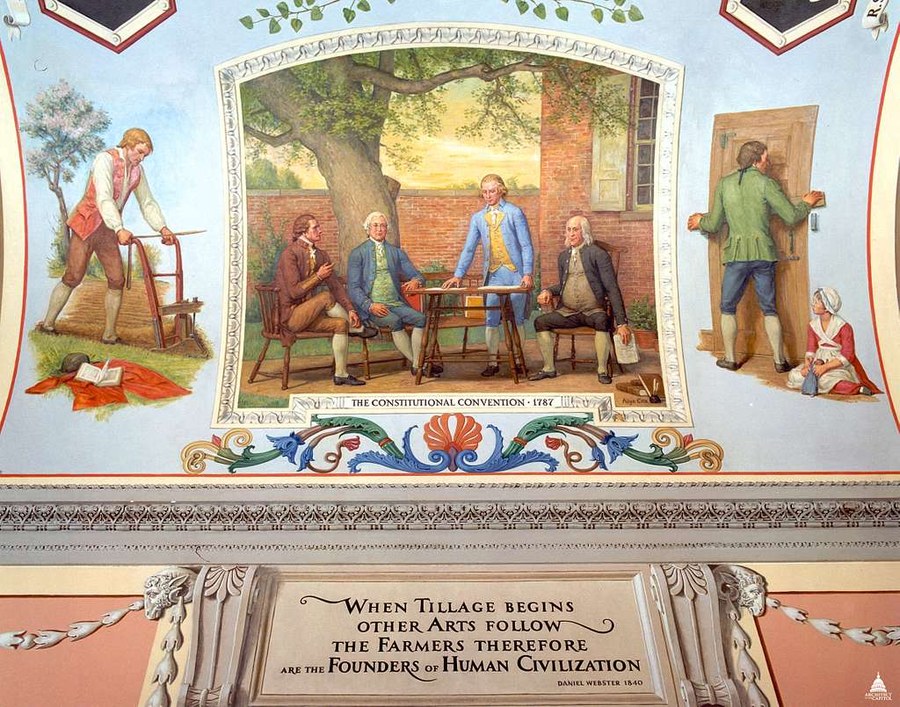
One morning, a delegate dropped his copy of the secret working propositions. Thomas Mifflin found it and handed it to Washington. At adjournment, Washington rose, laid the paper on the table, and said he did not know whose it was but that the owner should take it. He then walked out in a silence so severe that no one ever claimed the sheet. William Pierce later admitted he panicked, thinking the paper was his, until he found his own copy in another coat.
The famously bold Gouverneur Morris bet Alexander Hamilton that he could treat George Washington like an ordinary man. At a gathering, Morris walked up, slapped the general on the back, and asked, “Ain’t I right, General?” Washington’s look, Morris later said, made him wish the floor would open. No one else in the room spoke.
Abraham Baldwin of Georgia cast a vote that kept the small states from walking out. By siding with them on representation, he forced the creation of the Grand Committee that produced the Connecticut Compromise.
The windows of the State House stayed shut all summer so that eavesdroppers could not hear. William Paterson of New Jersey called Philadelphia “the warmest place I have ever been in.”

Alexander Hamilton spoke for an entire day on June 18, sketching a government so energetic that many delegates thought it edged toward monarchy. The speech changed few votes, but Hamilton signed the Constitution nonetheless.
George Mason, Elbridge Gerry, and Edmund Randolph were present on September 17 but refused to sign. Mason feared an executive that was too strong. Gerry objected to the absence of a bill of rights, among other concerns. Randolph wanted a second convention.
“A republic, if you can keep it.” That was Benjamin Franklin’s answer when Elizabeth Willing Powel asked him, outside the hall after adjournment, what form of government the delegates had created.
“I have the happiness to know that it is a rising and not a setting sun.” — Benjamin Franklin, on September 17, remarking on the sun painted on a chair
“It appears to me little short of a miracle that the delegates from so many different states should unite in forming a system of national Government so little liable to well-founded objections.” — George Washington
“We have been assured . . . that ‘except the Lord build the house, they labor in vain that build it.’ I firmly believe this.” — Benjamin Franklin, urging daily prayer
“The rule [of secrecy] was a prudent one not only as it will effectually secure the requisite freedom of discussion, but it will save both the Convention and the Community from a thousand erroneous and perhaps mischievous reports.” — James Madison, June 1787
“I consent to this Constitution because I expect no better, and because I am not sure that it is not the best.” — Benjamin Franklin, closing speech, September 17, 1787
“When you assemble a number of men to have the advantage of their joint wisdom, you inevitably assemble with those men all their prejudices, their passions, their errors of opinion, their local interests, and their selfish views.” — Benjamin Franklin
“If to please the people, we offer what we ourselves disapprove, how can we afterwards defend our work? Let us raise a standard to which the wise and honest can repair. The event is in the hand of God.” — George Washington, early in the convention
Today, our Constitution is under constant attack.
Democrats oppose freedom of speech—they embrace censoring conservatives and any speech they hate, while openly advocating for harm against President Trump and conservative leaders. Likewise they target the Second Amendment and any means for self-defense while they defund the police. That increases fear in people, which reduces a willingness to fight back or ‘throw the bums out.’
The “democratic socialists” openly promise to overthrow the Constitution and establish a system literally based on the Politburos of the Soviet Union and Communist China: A single legislative body with an appointed president and courts similarly appointed and subordinate to the ruling legislature.
For more at least a couple decades, Democrat politicians, schools, universities, the liberal media and Democrat activists have bitterly attacked the Constitution. “It’s racist” they scream. “It’s outdated.” “It doesn’t guarantee welfare for everyone.” “It doesn’t ban speech we hate.” “Firearms must be banned.” And on and on.
As part of the campaign to delegitimize the Constitution, they have torn down statues of the Founders, and branded them as incorrigibly racist.
Had Kamala Harris been elected, the “America 250” events would have not been a celebration of our liberty and independence, but a year-long indoctrination in why the Constitution must be replaced or amended to radical left-wing standards.
The propaganda against America and our constitutional system has reduced the numbers of people who are proud of America. We hope the focus on our 250th anniversary will reverse that trend.
Another threat comes from groups on both the left and the right advocating an “Article V Constitutional Convention,” to pass constitutional amendments without Congress. There is little to prevent such a convention from becoming a ‘runaway’ convention under control of the radical Left where the Constitution could be amended beyond recognition or completely rewritten—and they could even change the method of ratification to one under control by the Left. Read the TCC Foundation paper by Art Harman on the dangers of such a convention.
The late constitutional champion Phyllis Schlafly summed up the dangers of such a convention with these words of warning:
“The whole process is a prescription for political chaos, controversy and confrontation. Alas, I don’t see any George Washingtons, James Madisons, Ben Franklins or Alexander Hamiltons around today who could do as good a job as the Founding Fathers, and I’m worried about the men who think they can.”
— Phyllis Schlafly
It’s time to repeal violations of the Fourth Amendment under the Patriot Act and FISA updates
Congress rushed the Patriot Act through weeks after the 9/11 attacks with almost no hearings and with support by both Democrats and Republicans. It was the ultimate implementation of Rep. Nancy Pelosi’s later directive that “we have to pass the bill so that you can find out what is in it.”
The law created tools that bypass probable-cause warrants, allowing ‘sneak-and-peek’ searches, access to purchase and email records, as well as mandating bank activity alerts. In 2008, this surveillance authority was expanded with the Foreign Intelligence Surveillance Act (FISA).
Those are violations of the Fourth Amendment, and Conservatives and civil libertarians seek full repeal of the Patriot Act and related laws.
There is some good news: FISA’s Section 702 and FISA Title VII were not renewed by Congress this year. The law lapsed at the end of June 12, 2026, the first extended lapse since 702 was enacted in 2008. The House and Senate short-term extensions failed and it still had not been reauthorized. However the 2001 Patriot Act is mostly still in force.
You can help by asking your members of Congress to fully repeal the Patriot Act and remaining elements of the FISA.
This year’s Semiquincentennial celebration of our independence brought about a great patriotic appreciation for our Founding.
Many schools taught more about our independence and our constitutional rights and responsibilities. Even through the left-wing media filter, Americans seemed joyous about our founding.
Indeed, web searches for terms relating to the Declaration and our Founding spiked this year compared to others.
There’s no doubt God had a hand in the creation of the greatest constitution in history; the one that doesn’t award revocable rights, but supports the Declaration’s statement that “all men are created equal, that they are endowed by their Creator with certain unalienable Rights”
Together, we can—and must—keep and increase the interest in our Founding and to educate people how Democrats intend to destroy our constitutional rights.
Please use social media. Urge everyone to read the Constitution. Talk to students. Speak at civic organizations. Call talk shows. Write letters to the editor. Together, we can help keep our Constitution and our liberties for the next generation and for another 250 years.
— Art Harman, Senior Vice President – Policy, The Conservative Caucus
SHARE THIS ANALYSIS
Support Independent Conservative Analysis
Your donation keeps The Conservative Caucus holding government accountable since 1974.
About the author: Art Harman is Senior Vice President – Policy at The Conservative Caucus.
About The Conservative Caucus: Founded in 1974, The Conservative Caucus is a grassroots public policy action organization. Under President Jim Pfaff, the Caucus advances free enterprise, limited government, and traditional values.
Published September 17, 2026 by The Conservative Caucus.


 Peter J. Thomas is a veteran conservative political strategist and seasoned policy expert dedicated to upholding the principles of the Constitution and democracy. As a founder and the chairman of the Conservative Caucus, he has played a pivotal role in promoting and shaping the conservative agenda across the nation for over half a century.