
By Art Harman, Senior Vice President – Policy, The Conservative Caucus
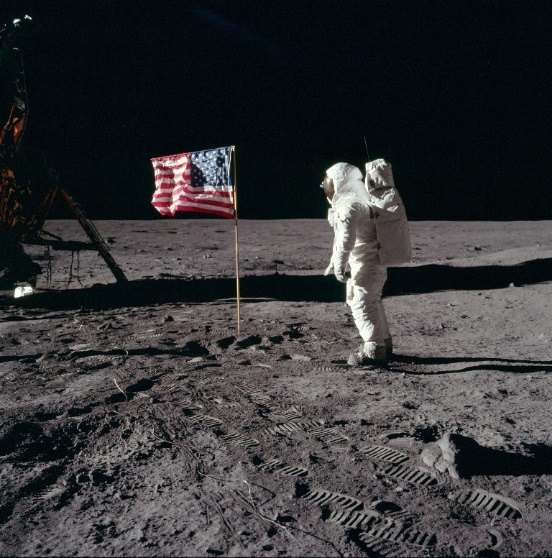
Today is the 57th anniversary of America’s greatest and boldest technological triumph: landing on the Moon and returning our astronauts safely to Earth.
This is also the 50th anniversary of the first lander on Mars, NASA’s Viking-I, which paved the way for the Mars rovers that have been exploring the red planet for three decades.
On July 16, the three astronauts, Neil Armstrong, Buzz Aldrin and Michael Collins launched from the Kennedy Space Center on their journey to the Moon.
Each step was fraught with danger. Over a million components had to work perfectly —and a failure in any one could cause the mission to fail. There were about 400,000 Americans who built the Apollo system and infrastructure, each working with the pride of contributing to the success.
Once in lunar orbit on the 20th, Armstrong and Aldrin climbed into the lunar lander to descend to the Moon. Collins’ duty was to remain in lunar orbit, keeping the spacecraft in the proper orbit for the others to return to from the Moon.
Armstrong had to manually steer the spacecraft across boulders that would destroy the fragile spacecraft. Following the landing, Armstrong radioed “Houston, Tranquility Base here. The Eagle has landed.”
What were their thoughts at the time? Aldrin once said about taking his first step on the Moon, “What was I supposed to be thinking? As far as I was concerned, I was following the checklist.” That’s fighter-pilot training!
They had trained every single step on Earth until each step was automatic, and their total attention was on safely accomplishing those items—including stepping on the surface of the Moon.
Neil Armstrong’s statement will be remembered throughout human history: “That’s one small step for a man, one giant leap for mankind.” Buzz Aldrin proclaimed, “Magnificent desolation.”
While on the Moon, they planted the American flag, spoke to President Richard Nixon, set up scientific instruments, and collected 47.5 pounds of lunar rocks.

The return to Earth on July 24th was watched by millions, ending with the splashdown in the Pacific. Then the national and worldwide celebrations began. Everywhere they went, they were received as heroes, with “ticker-tape” parades and thronging crowds eager to catch a glimpse.
Apollo 12 through 17 returned us to the Moon for more in-depth research, and collecting different types of lunar rocks. Apollo 13 suffered a terrible explosion, which famously took the best efforts of the astronauts and the ground crews to successfully return the crew.
After Apollo

The lunar future was cancelled. Politicians raided NASA’s budget for welfare and pork barrel projects.
The original plan was to build a manned lunar base in the 1970s and to send astronauts to Mars in the 1980s.
With funding and lowered interest by Washington, we built the space shuttles and the International Space Station. We learned a lot in those years, but exploration beyond earth was relegated entirely to robotic spacecraft and the Mars rovers.
Back to the Moon!
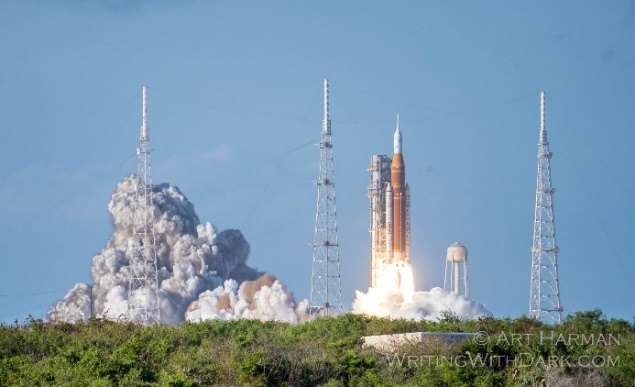
Today, America is back on track to land on the Moon—thanks to President Trump.
Artemis II took our astronauts to orbit the moon this April. Artemis III will launch next year to dock with the SpaceX and Blue Origin landers, and then in 2028, Artemis IV will land our astronauts on the Moon.
China’s threats to claim the Moon are not just academic. As in the South China Sea, they effectively declared ownership of the Moon and Mars, therefore, we must hurry.

Looking ahead, NASA is partnering with commercial ventures for Artemis, and in the early 2030s we will build a NASA and commercial lunar base.
Within a decade, YOU might be able to fly to Earth orbit for about the cost of a luxury cruise.

And one day in the not-too-distant future, children will look up at the Moon, point to the lights shining down and exclaim, “there’s people up there!” A sign that humanity has expanded to bases and eventually cities on the Moon and later on Mars.
American exceptionalism and our free enterprise system invented and built the greatest technological advances ever. As long as we reject the Democrat-socialist cabal which would destroy our constitutional system and institute a totalitarian system, our future in space as on Earth will be bright and prosperous.
Ad Astra.
— Art Harman, Senior Vice President – Policy, The Conservative Caucus
SHARE THIS ANALYSIS
Support Independent Conservative Analysis
Your donation keeps The Conservative Caucus holding government accountable since 1974.
About the author: Art Harman is Senior Vice President – Policy at The Conservative Caucus.
About The Conservative Caucus: Founded in 1974, The Conservative Caucus is a grassroots public policy action organization. Under President Jim Pfaff, the Caucus advances free enterprise, limited government, and traditional values.
Published July 20, 2026 by The Conservative Caucus.


 Peter J. Thomas is a veteran conservative political strategist and seasoned policy expert dedicated to upholding the principles of the Constitution and democracy. As a founder and the chairman of the Conservative Caucus, he has played a pivotal role in promoting and shaping the conservative agenda across the nation for over half a century.