

Jim Pfaff on John Fredericks: Indiana Chamber Blocks Redistricting | Dec 10, 2025
Published: December 10, 2025
Network: John Fredericks Media
Analysis: Conservative Caucus President Jim Pfaff
The Indiana Chamber of Commerce is leading the charge to defeat a Republican redistricting plan that could deliver two additional congressional seats to the GOP—and they’re doing it by working hand-in-glove with Democratic operatives. In a revealing discussion with John Fredericks, Conservative Caucus President Jim Pfaff and election law expert Phil Kline exposed how the state’s business lobby has become the primary obstacle to Republican electoral success, promising committee assignments to legislators who vote against their own party’s interests.
Topics Covered
- The Chamber of Commerce Betrayal of Conservative Values
- Indiana’s Redistricting Battle: 26 Votes Stand Between Victory and Defeat
- How Corporate Lobbies Captured the Republican Party
- The Grassroots Solution to Political Cowardice
- Key Takeaways
The Chamber of Commerce Betrayal of Conservative Values
The Indiana Chamber of Commerce has emerged as the leading force blocking Republican redistricting in the Hoosier State, but this represents a much larger pattern of corporate betrayal across America. Jim Pfaff didn’t mince words about the organization’s role: “The Indiana Chamber of Commerce is even worse” than the U.S. Chamber, which actively worked to defeat Donald Trump in 2020.
“The Indiana Chamber of Commerce really is disgusted by what Donald Trump stands for. They hate the social issues, but they also are always working in the state legislature to take care of getting money for their cronies.”
— Jim Pfaff, President, The Conservative Caucus
The problem extends far beyond Indiana. Phil Kline, former Kansas Attorney General and election law expert, emphasized that chambers of commerce nationwide have abandoned Republican principles in favor of protecting the status quo and enriching their donors. “The Republican Party lost the business community because they started playing the game of using regulation to hurt their competitors and using governmental power to line pockets,” Kline explained.
This shift represents a fundamental realignment in American politics. While President Trump successfully peeled away union support from Democrats, traditional business lobbies like the U.S. Chamber of Commerce have moved leftward, supporting big government candidates and opposing the America First agenda.
The Time Magazine Revelation
A 2020 Time Magazine article documented how the U.S. Chamber of Commerce actively collaborated with union organizations to defeat Donald Trump’s reelection. This wasn’t speculation or conspiracy theory—it was openly admitted coordination between supposed adversaries united in their opposition to the America First movement.
Indiana’s Redistricting Battle: 26 Votes Stand Between Victory and Defeat
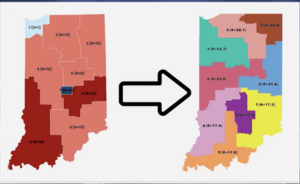
The immediate crisis centers on Indiana’s state Senate, where Republicans need just 26 votes to pass a redistricting plan that would create two additional GOP congressional seats. Senate President Roderick Bray needs only two more votes to secure passage—but he’s working against his own party to defeat it.
According to Pfaff, who has been personally involved in Indiana politics since the 1990s and helped elect some of the very legislators now opposing redistricting, Bray is “leading the fight to defeat the redistricting” by promising committee assignments to senators who vote no. “He’s doing the opposite. He’s working for basically the Democratic Party of Indiana. I mean, it’s bizarre,” Pfaff said.
The irony couldn’t be sharper: In a solidly pro-Trump state where Republicans control the legislature, GOP leadership is actively working to prevent their party from gaining congressional seats. The obstruction isn’t coming from Democrats—it’s coming from within the Republican caucus itself, with the Indiana Chamber of Commerce providing the political cover and pressure.
“These people are not committed in the least to conservative ideals, to Republican ideals, to constitutional ideals… The people of Indiana are pro-Trump, by the way. They’re going against their own constituents in a Republican state. It’s crazy.”
— Jim Pfaff
The contrast with Democratic tactics is instructive. Pfaff pointed to Illinois, where Democrats have created at least nine gerrymandered districts snaking out from Cook County, including one stretching from Chicago’s south side nearly to Carbondale—halfway across the state. “This is how serious Democrats have been in this redistricting. And Republicans need to understand that if we don’t counter it… Democrats have thrown that out the window,” he said.
How Corporate Lobbies Captured the Republican Party
The discussion revealed how corporate interests have systematically captured regulatory agencies and used government power to eliminate competition—all while funding Republican campaigns and controlling party infrastructure. The pattern repeats across industries: banking, pharmaceuticals, agriculture, and beyond.
Phil Kline provided a stark example from his time as Kansas Tax Committee Chairman: “We proposed significant tax cuts. The opponents, the Kansas Chamber of Commerce, and the local chambers.” When Kline threatened to go directly to chamber members with the truth, the organization suddenly reversed course. “They do not support their membership agenda,” he concluded.
The FDA’s origin story, as recounted by Pfaff, perfectly illustrates the problem. The Heinz Corporation, facing competition in the ketchup market from smaller producers, convinced President Theodore Roosevelt that these competitors were unsafe—even claiming they put sawdust in their products. The result? Creation of the Food and Drug Administration to eliminate Heinz’s competition through regulatory barriers.
The Banking Consolidation Scandal
During the 2008 financial crisis, the federal government gave $800 billion to large banks through TARP while the FDIC simultaneously shut down small community banks across America. The number of charter banks plummeted from 14,000 before 2008 to just 4,000 today. Small banks were closed and their assets handed to larger institutions—without due process or the ability to challenge the seizures. This wasn’t market consolidation; it was government-engineered wealth transfer to politically connected corporations.
This corporatist model has infected the Republican campaign apparatus itself. The National Republican Congressional Committee (NRCC) steers new candidates toward favored consultants and media buyers who take their cut, while discouraging the grassroots organizing that actually wins elections. “One of the reasons I got close, came to get to know Phil Klein and became close friends with Tim Huelskamp,” Pfaff explained, was working on Kansas’s marriage amendment campaign, which more than doubled typical off-year turnout through pure grassroots mobilization—from 17.8% to 39.5%.
“The Republican Party doesn’t work the grassroots because they don’t message to normal folks. They message to big corporations that Democrats really have a greater stranglehold on than them right now, but they keep going after that rather than getting to average people and the issues that matter to them.”
— Jim Pfaff
The Grassroots Solution to Political Cowardice
The path forward requires conservatives to recognize and exploit a key weakness: establishment Republicans operate from fear. As Phil Kline put it succinctly, “There’s one good thing about a weak Republican. They operate out of fear. So if you frighten them by showing up, they’ll change their vote.”
The disparity in activist engagement was on full display at the Indiana Capitol. When Fredericks observed a recent protest, he counted approximately 375 people—with 350 being Democratic operatives with signs, yelling and making their presence known. The Republican side? Ten people. “You can’t win,” Fredericks declared. “You have got to get involved.”
This activism gap explains why chambers of commerce wield disproportionate influence despite representing a tiny fraction of voters. They show up. They lobby. They threaten. Meanwhile, the conservative base—which vastly outnumbers chamber lobbyists—remains largely absent from state capitols where critical decisions are made.
The solution isn’t complicated: massive grassroots mobilization. Pfaff called for Indiana residents to flood the state capitol and demand action from their representatives. When legislators see hundreds or thousands of constituents making their voices heard, the political calculus changes instantly. Committee assignments and chamber donations mean nothing compared to an aroused electorate threatening primary challenges.
Trump’s Administrative State Battle
President Trump currently faces 531 lawsuits challenging his executive orders aimed at dismantling the administrative state and firing career bureaucrats who serve corporate interests rather than the public. Congress could end these lawsuits immediately by ratifying the President’s actions through legislation. The failure to do so reveals how deeply the corporatist consensus runs through both parties—and why grassroots pressure on individual legislators matters more than ever.
Kline suggested conservatives should consider abandoning chambers of commerce entirely and forming alternative business organizations aligned with constitutional principles and free market economics rather than crony capitalism. “I think people ought to consider leaving the chambers of commerce and forming another organization,” he said, noting this applies to “all across the board with these alphabet groups that are in there to consolidate their power, consolidate the wealth of their primary contributors.”
The stakes extend far beyond Indiana’s redistricting fight. If the current system continues—with chambers of commerce and corporate lobbies controlling Republican legislators while Democrats ruthlessly pursue every electoral advantage—the conservative movement will find itself permanently locked out of power despite winning popular support. As Pfaff warned, “If we cannot change a lot of this and start getting on a path of correction during Donald Trump’s term, we’re going to be in a worse situation than we were before Donald Trump came on the scene in 2016.”
Key Takeaways
- The Indiana Chamber of Commerce is actively blocking Republican redistricting – Despite GOP control of the state legislature in a pro-Trump state, the chamber is working with Senate President Roderick Bray to defeat a plan that would add two Republican congressional seats by promising committee assignments to legislators who vote against their party.
- Chambers of commerce nationwide have abandoned conservative principles – The U.S. Chamber of Commerce worked to defeat Trump in 2020, and state chambers consistently oppose Republican reforms while protecting corporate cronies and big government spending that benefits their donors.
- Regulatory capture allows big corporations to eliminate competition – From the FDA’s creation by Heinz Corporation to crush ketchup competitors, to the FDIC closing 10,000 small banks during the financial crisis while bailing out large institutions, government agencies serve corporate interests rather than free markets.
- Weak Republicans respond to pressure – Establishment legislators operate from fear and will change their votes when confronted with grassroots mobilization, but conservatives must actually show up to state capitols and make their voices heard.
- The Republican campaign apparatus serves consultants, not candidates – The NRCC steers candidates toward favored media buyers and consultants who take their cut while discouraging the grassroots organizing that actually wins elections and builds lasting political movements.
- Trump’s battle against the administrative state requires congressional support – The President faces 531 lawsuits over his efforts to control the executive branch and fire career bureaucrats, but Congress could end these challenges by ratifying his actions through legislation—revealing which Republicans truly support reform versus the status quo.
- Time is running out – If the corporatist consensus isn’t broken during Trump’s term, the conservative movement will face permanent electoral disadvantage as Democrats continue aggressive redistricting while Republican leaders sabotage their own party’s efforts.
Share This Analysis
Connect With The Conservative Caucus
Stand with thousands of Americans defending constitutional principles and the rule of law.
About The Conservative Caucus:
The Conservative Caucus is a grassroots public policy action organization, formed in 1974. Headed by President Jim Pfaff, the Caucus is committed to advancing free enterprise, limited government, and traditional values.
Originally broadcast December 10, 2025 on John Fredericks Media.


 Peter J. Thomas is a veteran conservative political strategist and seasoned policy expert dedicated to upholding the principles of the Constitution and democracy. As a founder and the chairman of the Conservative Caucus, he has played a pivotal role in promoting and shaping the conservative agenda across the nation for over half a century.