

Democrats No Longer American Party: 2026 Stakes | Apr 6, 2026
Published: April 06, 2026
Network: One America News
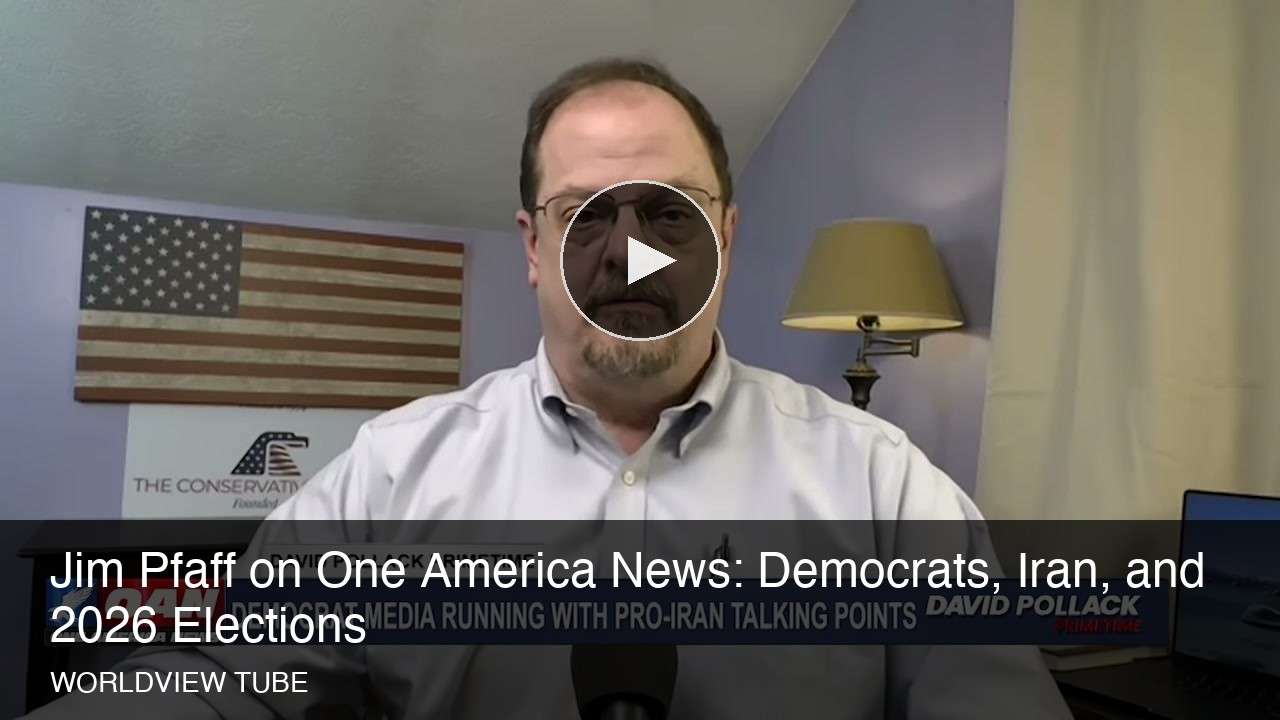
Analysis: Conservative Caucus President Jim Pfaff
Topics Covered
- Democrats and Iran Policy: A Pattern of Inaction
- Why 2026 and 2028 Elections Are Critical
- The Claim That Democrats Are ‘No Longer an American Party’
- Democratic Strategy: Impeachment and Lawfare
- Iran’s Role as a Global Threat
Democrats and Iran Policy: A Pattern of Inaction
For decades, American foreign policy toward Iran has oscillated between strength and appeasement, depending largely on which party controls the levers of power in Washington. The record is clear: when conservatives lead, Iran faces consequences for its malign activities. When Democrats take charge, the Islamic Republic receives breathing room to expand its influence, fund terrorism, and advance its nuclear ambitions.“Democrats clearly have not done anything to stop Iran.”This assessment from Pfaff cuts to the heart of the matter. Throughout multiple Democratic administrations, we have witnessed a consistent pattern of policies that embolden rather than constrain Iranian aggression. The Biden administration’s approach exemplified this troubling tendency, with efforts to revive nuclear agreements that provided Iran with economic relief while doing little to address its ballistic missile program, support for terrorist proxies, or human rights abuses against its own citizens. The consequences of this inaction extend far beyond the Middle East. Iranian-backed militias have attacked American service members, Iranian drones have been supplied to Russia for use against Ukraine, and Iranian influence has destabilized nations from Yemen to Lebanon to Syria. Each instance of Democrats’ passivity has allowed these threats to metastasize. When Donald Trump implemented his maximum pressure campaign during his first term, Iran’s economy contracted significantly, limiting the regime’s ability to fund its proxy networks. The elimination of Qasem Soleimani demonstrated that American patience had limits and that those who orchestrated attacks against Americans would face justice. These actions, while criticized by Democrats at the time, represented the kind of decisive leadership that adversaries understand and respect. The concern now is that any future Democratic administration would simply reverse course, undoing the progress made and returning to the failed policies of appeasement. This cyclical approach to foreign policy undermines American credibility and emboldens our enemies, who need only wait for the next election to see if they can outlast American resolve.
— Jim Pfaff, President, The Conservative Caucus
Why 2026 and 2028 Elections Are Critical for Donald Trump’s Legacy
The upcoming electoral cycles represent more than typical midterm and presidential contests. They will determine whether the policies and reforms implemented under conservative leadership can be sustained or whether they will be dismantled by Democrats who have made their intentions abundantly clear.“Every election is the most important election of our lives.”Pfaff acknowledges that this phrase has become something of a political cliché, often deployed by both parties to motivate their bases. However, he argues that recent history has validated this sentiment in ways that previous generations could not have anticipated. The stakes have genuinely escalated, and the differences between the two major parties have become so fundamental that electoral outcomes now carry existential implications for the American experiment itself. The 2026 midterm elections will determine control of Congress, which in turn will determine whether the current administration can continue implementing its agenda or whether it will face obstruction and, potentially, impeachment proceedings. Democrats have already signaled their intentions to pursue such measures if they regain legislative power, making these elections a referendum on whether voters want to see governance or gridlock. Looking ahead to 2028, the presidential election will determine the long-term trajectory of American policy on issues ranging from Iran to immigration to economic reform. The work being done now to confront threats abroad and restore constitutional governance at home could be undone within months of a Democrats victory. This is not speculation but rather a reasonable projection based on explicit statements from Democratic leaders about their intentions. For supporters of the America First agenda, complacency is not an option. Every election must be treated as consequential because, in the current political environment, every election genuinely is consequential. The margin between continued progress and complete reversal is measured in votes, and those votes must be earned through engagement, persuasion, and turnout.
— Jim Pfaff, President, The Conservative Caucus
The Claim That Democrats Are ‘No Longer an American Party’
Perhaps the most provocative assertion in Pfaff’s analysis concerns the fundamental nature of the modern Democratic Party. This is not merely partisan rhetoric but rather a serious argument about ideological transformation that deserves careful consideration.“They are no longer an American party. They aren’t an American party. They don’t believe in the original American ideal.”What does it mean to say that a major political party is no longer “American” in its orientation? Pfaff’s argument centers on the founding principles of the republic: limited government, individual liberty, federalism, and the rule of law as established by the Constitution. These principles, he contends, are no longer embraced by Democrats, who have instead adopted a progressive ideology that seeks to fundamentally transform rather than preserve American institutions.
— Jim Pfaff, President, The Conservative Caucus
“Democrats are committed to something other than America.”This commitment to “something other than America” manifests in various ways. We see it in the embrace of globalist frameworks that subordinate American sovereignty to international bodies. We see it in the promotion of identity politics that divide Americans into competing groups rather than uniting them around shared citizenship. We see it in the expansion of federal power at the expense of states and individuals. And we see it in the willingness to use governmental institutions as weapons against political opponents. The accusation that Democrats seek permanent power is supported by their policy preferences on issues like voting procedures, immigration, and court-packing. Each of these positions, critics argue, is designed to create structural advantages that would make future Republican victories increasingly difficult to achieve.
— Jim Pfaff, President, The Conservative Caucus
“They do want to have power in perpetuity.”Whether one accepts this characterization in full or views it as overstated, the underlying concern about the direction of the Democratic Party is shared by millions of Americans who feel increasingly alienated from an institution that once represented working-class interests and now seems captured by coastal elites and academic ideologues.
— Jim Pfaff, President, The Conservative Caucus
Democratic Strategy: Impeachment and Lawfare Against Donald Trump
The playbook for opposing conservative governance has become depressingly predictable. Rather than competing on policy grounds and accepting electoral outcomes, Democrats have increasingly turned to institutional mechanisms designed to delegitimize, obstruct, and ultimately remove their opponents from power. Pfaff outlines a two-step strategy that Democrats are pursuing. The first step involves regaining control of Congress, or at least one chamber, in the 2026 midterms. This would provide the platform necessary to launch impeachment proceedings against the current administration, regardless of whether such proceedings have any legitimate basis. The second step involves winning the presidency in 2028 and using the executive branch to resume the lawfare campaigns that characterized previous efforts to target Donald Trump and his associates. This includes politically motivated prosecutions, weaponized regulatory agencies, and the use of the justice system to punish enemies rather than pursue justice. This strategy represents a fundamental departure from democratic norms. Impeachment was designed as a remedy for genuine high crimes and misdemeanors, not as a routine tool of political opposition. Lawfare transforms the legal system from a neutral arbiter into a partisan weapon. Together, these tactics threaten to make peaceful transitions of power impossible by ensuring that every administration faces existential legal threats from its successor. The willingness of Democrats to embrace these tactics, even while accusing their opponents of threatening democracy, reveals a troubling lack of self-awareness or, worse, a cynical understanding that accusations of authoritarianism provide cover for authoritarian behavior. For conservatives, the response must be both defensive and proactive. Defensively, this means winning elections to prevent Democrats from obtaining the power necessary to implement their strategy. Proactively, it means reforming institutions to prevent their weaponization and holding accountable those who have abused their positions.Iran’s Role as a Global Threat
While much of the political debate focuses on domestic concerns, the threat posed by Iran remains a pressing national security issue that demands sustained attention. Pfaff places Iran in context within the broader landscape of global threats, noting that while China and Russia may represent larger strategic challenges, Iran’s role as an instigator and facilitator of instability makes it uniquely dangerous. Iran’s threat profile is multifaceted. Its nuclear program, despite various agreements and inspections, continues to advance toward weapons capability. Its ballistic missile arsenal threatens American allies throughout the Middle East and increasingly has the range to threaten European capitals. Its network of proxy forces, including Hezbollah, Hamas, and various Iraqi and Yemeni militias, allows it to project power and conduct attacks while maintaining plausible deniability. Perhaps most concerning is Iran’s role in facilitating the activities of larger adversaries. Iranian drones supplied to Russia have been used to attack Ukrainian infrastructure, demonstrating how regional threats can contribute to broader conflicts. Iranian cooperation with China on energy and trade undermines international sanctions and provides the regime with economic lifelines that sustain its malign activities.“They’re looking for the overthrow of the American Republic so they can reform it and refashion it into something that they desire to do, which really has Maoist communist roots to it.”This assessment connects the foreign policy debate to the broader ideological struggle. Those who would weaken America’s response to threats like Iran are not merely making strategic errors but are, in Pfaff’s view, pursuing a deliberate agenda to diminish American power as part of a larger project of transformation. The path forward requires sustained pressure on Iran, support for its domestic opposition, and coordination with allies who share our concerns about the regime’s behavior. It also requires political continuity, ensuring that policies implemented today are not reversed tomorrow by an administration more sympathetic to accommodation than confrontation.
— Jim Pfaff, President, The Conservative Caucus
Key Takeaways
- Democratic Iran Policy Has Failed: Years of inaction and appeasement have allowed Iran to expand its influence, fund terrorism, and advance toward nuclear capability, threatening American interests and allies throughout the Middle East and beyond.
- 2026 and 2028 Elections Are Genuinely Critical: These are not ordinary electoral cycles but rather decisive moments that will determine whether conservative reforms can be sustained or whether they will be reversed by opponents committed to a different vision for America.
- The Democratic Party Has Undergone Ideological Transformation: According to Pfaff’s analysis, the modern Democratic Party no longer embraces the founding principles of the American republic and instead pursues a progressive agenda with roots in ideologies foreign to the American tradition.
- Impeachment and Lawfare Are Central to Democratic Strategy: Rather than competing on policy, Democrats plan to use institutional mechanisms to obstruct, delegitimize, and remove conservative leaders from power, threatening democratic norms in the process.
- Iran Remains a Serious Global Threat: While not the largest adversary America faces, Iran’s role as an instigator and facilitator of instability makes it uniquely dangerous and requires sustained attention and pressure from American policymakers.
- Political Continuity Is Essential for National Security: Effective foreign policy requires consistency across administrations, making electoral outcomes directly relevant to America’s ability to confront threats and protect its interests abroad.
Share This Analysis
Join The Conservative Caucus
Stand with thousands of Americans defending constitutional principles and the rule of law.
About The Conservative Caucus:
The Conservative Caucus is a grassroots public policy action organization, formed in 1974. Headed by President Jim Pfaff, the Caucus is committed to advancing free enterprise, limited government, and traditional values.
Originally broadcast April 06, 2026 on One America News.


 Peter J. Thomas is a veteran conservative political strategist and seasoned policy expert dedicated to upholding the principles of the Constitution and democracy. As a founder and the chairman of the Conservative Caucus, he has played a pivotal role in promoting and shaping the conservative agenda across the nation for over half a century.